Why Most PMO Dashboards Fail Executives
Most PMO dashboards don’t fail because they lack data. They fail because they aren’t designed to force decisions. Executives don’t need more visibility. They need clearer tradeoffs, faster commitments, and fewer signals that actually change behavior.
Most executives don’t suffer from a lack of data.
They suffer from decisions that arrive too late — or not at all.
Dashboards are reviewed. Metrics are discussed. Slides advance.
And yet, the same tradeoffs resurface month after month.
The problem isn’t visibility.
It’s that most PMO dashboards were never designed to force decisions.
The Illusion of Visibility
Modern organizations are saturated with metrics.
Delivery health, capacity, risk, dependencies, financials — all carefully tracked, aggregated, and displayed. From the outside, it looks like clarity.
From the inside, executives are often still guessing.
Dashboards create the feeling of control without improving judgment.
Information moves. Decisions stall.
That gap is where execution quietly degrades.
Dashboards Weren’t Built for Decisions
Most PMO dashboards answer the wrong question.
They ask:
- What happened?
- Where are we red, yellow, or green?
- Are we on track?
Executives rarely struggle with awareness.
They struggle with tradeoffs.
What they actually need to know is:
- What must change because of this signal?
- What decision is being forced now — not later?
- What are we choosing not to do if we proceed?
Dashboards that stop at status feel safe.
Dashboards that force choices feel uncomfortable.
So most organizations default to safety.
Reporting Comfort vs. Decision Tension
Status-oriented dashboards optimize for:
- Completeness
- Consistency
- Comparability
Decision-oriented dashboards optimize for:
- Relevance
- Timing
- Consequence
Those are not the same thing.
When dashboards are built to avoid friction, they anesthetize leadership.
When they are built to surface tension, they create momentum.
Most PMO dashboards fail because they do the former exceptionally well.
Why PMOs Keep Missing the Mark
This isn’t a competence issue.
It’s a positioning issue.
PMOs are often accountable for producing dashboards, but not for owning the decisions those dashboards are meant to inform.
That disconnect creates predictable patterns:
- Metrics without authority
- Signals without escalation paths
- Insights without consequence
When no one is explicitly responsible for what happens after a metric turns red, the dashboard becomes informational theater.
Clean. Accurate. Harmless.
Dashboards as Decision Interfaces
A useful executive dashboard answers three questions — clearly and repeatedly:
- What decision is this metric meant to inform?
- Who has the authority to act when it changes?
- What tradeoff becomes unavoidable because this is visible?
If those answers aren’t explicit, the dashboard will be reviewed — not used.
Dashboards don’t drive execution.
Decisions do.
Dashboards either sharpen judgment, or delay it.
What Changes When Dashboards Are Designed Intentionally
When dashboards are anchored to decisions:
- Fewer metrics matter more
- Escalation becomes structural, not political
- Leadership conversations shift from explanation to choice
The goal isn’t more transparency.
It’s faster, cleaner commitment.
The Strategic Reality
Executives don’t need more data.
They need fewer signals — with clearer consequences.
Dashboards fail when they protect leaders from discomfort.
They succeed when avoidance becomes impossible.
A dashboard isn’t broken because it’s inaccurate.
It’s broken when nothing changes because it exists.
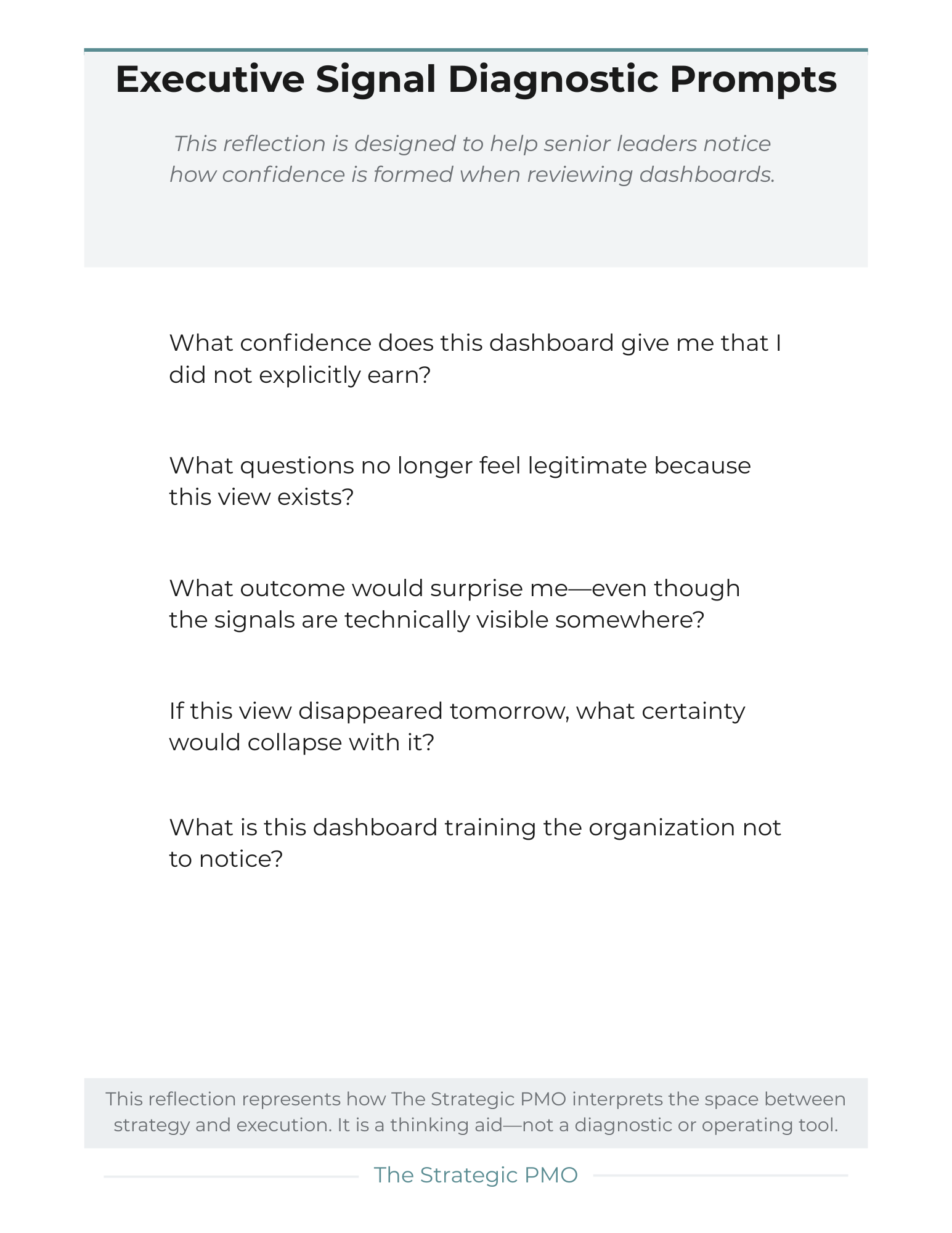
The reflection below is not meant to improve dashboards or suggest changes.
It exists to surface how confidence is formed — and sometimes misplaced — when executives review them.
Read the prompts slowly. If they feel uncomfortable, they’re doing their job.