
How Escalation — Actually Works
Most organizations think escalation failures happen because teams communicate too late. But in many cases, the issue was escalated. The problem is that the meaning of the signal changed as it moved upward through the organization.
Executives often ask the same question after a major delivery issue surfaces:
“Why wasn’t this escalated sooner?”
Usually, the assumption behind the question is that:
- communication failed,
- accountability broke down,
- or teams waited too long to raise the concern.
But in many organizations, the issue was escalated.
Multiple times.
The problem is that the meaning of the signal changed as it moved upward through the organization.
A delivery team identifies:
- dependency instability,
- unresolved architectural ambiguity,
- and growing coordination friction between teams.
At the operational layer, the concern feels serious.
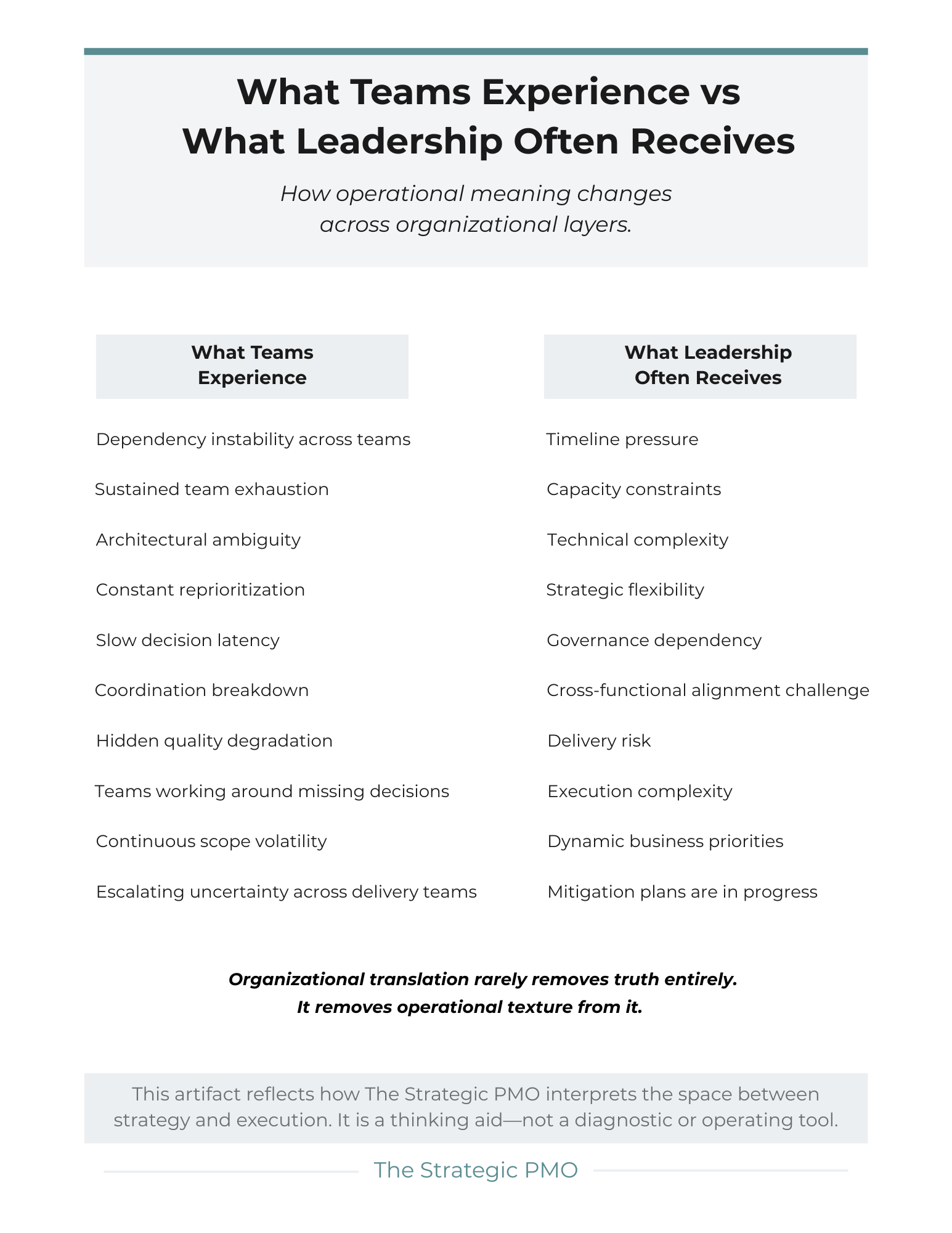
A week later, leadership hears:
“There may be some timeline pressure.”
Two weeks later:
“Mitigation plans are in progress.”
A month later:
“Delivery confidence remains intact.”
Then the initiative slips.
Dependencies collapse.
Quality degrades.
Confidence disappears.
And leadership asks:
“Why didn’t anyone escalate this?”
But someone did.
The signal just degraded across hierarchy.
Most organizations think escalation is fundamentally:
- a governance process,
- a communication path,
- or a reporting mechanism.
But escalation is really about something else entirely:
preserving operational meaning as information moves through the organization.
And most organizations are much worse at that than they realize.
Escalation Is Really About Signal Preservation
Organizations rarely transmit information upward unchanged.
Every layer:
- interprets,
- reframes,
- compresses,
- and contextualizes what it receives.
No signal moves through hierarchy untouched.
By the time information reaches executives, it has usually become:
- synthesized,
- normalized,
- politically softened,
- and compressed into digestible language.
That process is not inherently malicious.
In many ways, it is necessary.
Executives cannot consume raw operational detail at scale. Organizations require abstraction to function.
But abstraction comes with tradeoffs.
As signals move upward:
- ambiguity gets reduced,
- urgency softens,
- nuance disappears,
- and confidence language increases.
The organization optimizes for digestibility.
Not necessarily fidelity.
Escalation is rarely blocked outright.
It is usually translated to death.
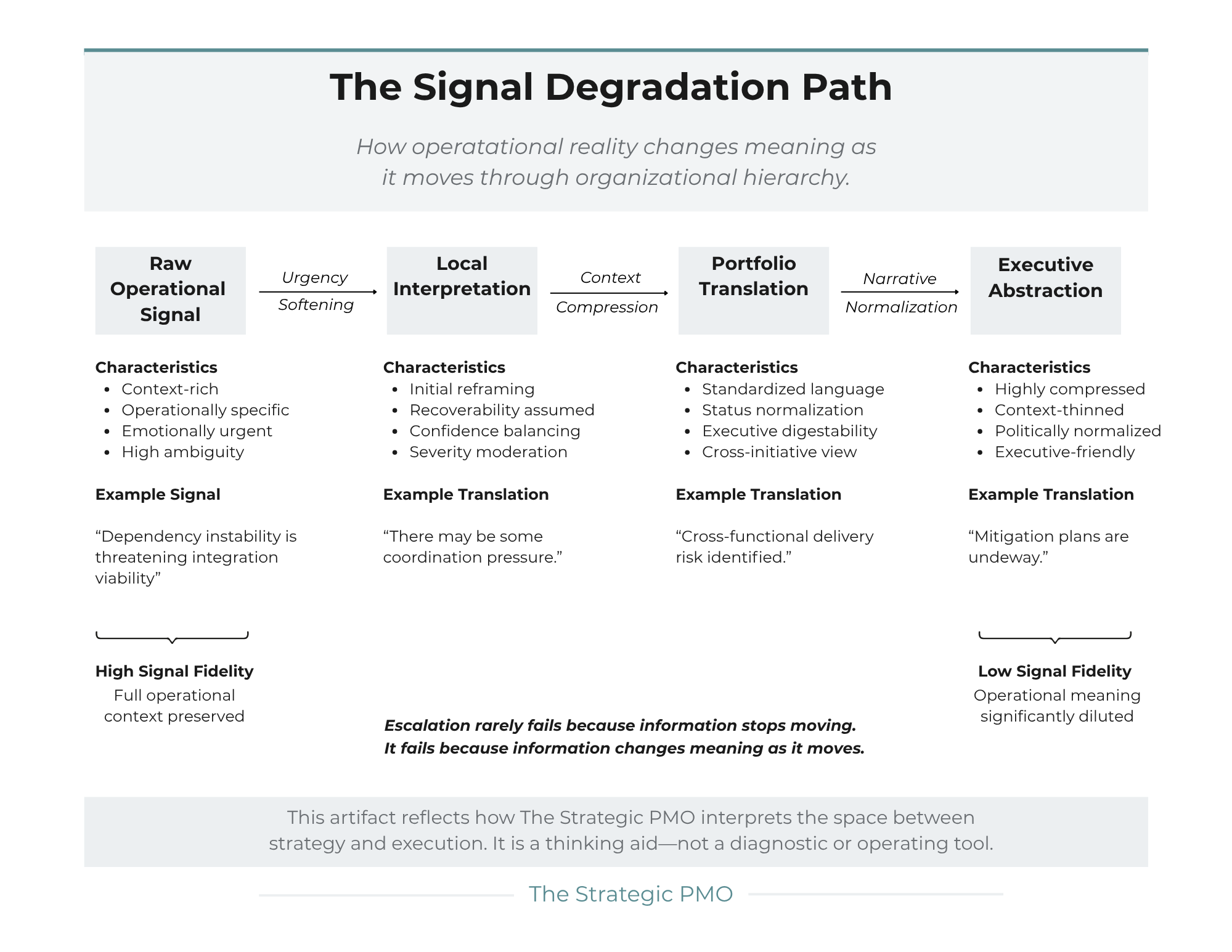
The Signal Degradation Path
Most execution problems follow a surprisingly consistent pattern.
Operational signals begin:
- context-rich,
- emotionally urgent,
- operationally specific,
- and often deeply ambiguous.
Teams feel the instability long before dashboards reflect it.
A dependency model begins weakening.
Architectural uncertainty grows.
Coordination friction increases.
Teams begin compensating manually for unresolved decisions.
At this stage, the signal still contains operational texture.
Then translation begins.
Managers attempt to balance:
- visibility,
- confidence,
- and recoverability.
Language softens:
- “manageable”
- “being monitored”
- “still evaluating”
- “likely recoverable”
The signal becomes easier to communicate upward.
But slightly less representative of reality.
Then portfolio systems take over.
The signal becomes:
- standardized,
- normalized,
- status-oriented,
- and executive-digestible.
It enters:
- red/yellow/green reporting,
- mitigation summaries,
- delivery variance discussions,
- and portfolio review language.
The farther the signal moves from execution, the cleaner it becomes.
And often, the less accurate it becomes.
That degradation path is rarely intentional.
It is systemic.
Organizations reduce cognitive load by compressing reality.
Why Organizations Naturally Degrade Signals
Signal degradation happens because organizations are designed to simplify complexity.
Hierarchy itself creates interpretation layers.
Every layer:
- filters information,
- reframes meaning,
- and determines what feels important enough to pass upward.
That process is unavoidable to some degree.
But several organizational dynamics accelerate degradation significantly.
Cognitive Compression
Executives cannot process raw operational detail across dozens or hundreds of initiatives simultaneously.
So organizations compress information.
They summarize.
Standardize.
Normalize.
Abstract.
The problem is not abstraction itself.
The problem is losing critical meaning during abstraction.
A dashboard may successfully communicate:
- schedule variance,
- risk status,
- or roadmap health
while completely obscuring:
- coordination instability,
- uncertainty accumulation,
- dependency fragility,
- or operational exhaustion underneath.
Organizations often maintain visibility while losing operational texture.
Political Filtering
Most organizations reward confidence signaling more than uncertainty visibility.
People quickly learn:
- not to sound alarmist,
- not to create executive anxiety,
- not to escalate prematurely,
- and not to appear out of control.
So language softens.
Risks become:
- “manageable”
- “contained”
- “being monitored”
Even when operationally, teams are increasingly uncertain.
The intent is usually stability.
But the effect is interpretive distortion.
Dashboard Abstraction
Dashboards create distance.
That does not make dashboards bad.
But dashboards flatten nuance by design.
A “yellow” initiative might contain:
- architectural instability,
- unresolved tradeoffs,
- staffing exhaustion,
- or coordination breakdown across teams.
But the abstraction compresses all of that into:
“delivery risk.”
The signal survives.
The texture does not.
Fragmented Interpretation
Sometimes organizations do not merely degrade signals.
They fragment interpretation around them.
Engineering may interpret a signal as:
architectural instability.
Product may interpret the same signal as:
roadmap pressure.
Finance may interpret it as:
investment inefficiency.
Leadership may interpret it as:
timeline risk.
Everyone appears aligned because they are discussing the same initiative.
But operationally, they are responding to very different realities.
The problem is rarely visibility alone.
It is the absence of shared meaning.
The Illusion of “Late Escalation”
Most major execution failures do not emerge suddenly.
They emerge gradually as weak signals.
And weak signals are easy to dismiss.
Early indicators:
- often feel ambiguous,
- appear recoverable,
- lack certainty,
- and rarely announce themselves dramatically.
So organizations rationalize them away.
Teams compensate.
Leaders normalize.
Dashboards stabilize.
Meetings soften language.
Over time, the organization gradually adapts to increasing instability until the problem becomes impossible to absorb quietly anymore.
That is why so many executive surprises feel sudden from the leadership layer while operational teams feel like they have been struggling with the issue for months.
Because they often have.
Organizations frequently confuse:
“nobody escalated”
with:
“the signal no longer sounded dangerous.”
That distinction matters.
Most executive surprises begin as operational whispers.
And those whispers often become progressively less recognizable as they move upward.
What Healthy Escalation Systems Actually Do
Healthy organizations are not the ones that eliminate escalation.
They are the ones that preserve meaning across layers.
That requires more than reporting discipline.
It requires organizational systems that preserve:
- nuance,
- ambiguity,
- uncertainty,
- and operational texture.
Strong organizations create direct pathways for weak signals to surface before they become executive surprises.
They create forums where:
- ambiguity is discussable,
- uncertainty is acceptable,
- and operational concerns do not need to be prematurely sanitized into executive-safe language.
Healthy operating mechanisms focus less on:
- status reporting
and more on:
- interpretation,
- signal analysis,
- emerging instability,
- and unresolved tradeoffs.
They recognize that execution problems are rarely invisible.
More often, they become normalized gradually.
Most importantly, healthy organizations reduce the political penalty for uncertainty visibility.
Teams should not feel forced to:
- project confidence prematurely,
- sanitize risk,
- or convert operational instability into reassuring narratives too early.
Healthy escalation systems do not eliminate hierarchy.
They reduce distortion across it.
The Real Leadership Question
Leaders often ask:
“Why wasn’t this escalated sooner?”
But the better question may be:
“At what point did the signal stop meaning the same thing across the organization?”
Because execution failure rarely begins with silence.
It usually begins with degraded interpretation.
Related Concepts
Many of the dynamics described in this essay connect to recurring concepts explored throughout The Strategic PMO, including:
- Escalation Integrity
- Signal Degradation
- Operational Texture
- Coordination Friction
- Decision Architecture